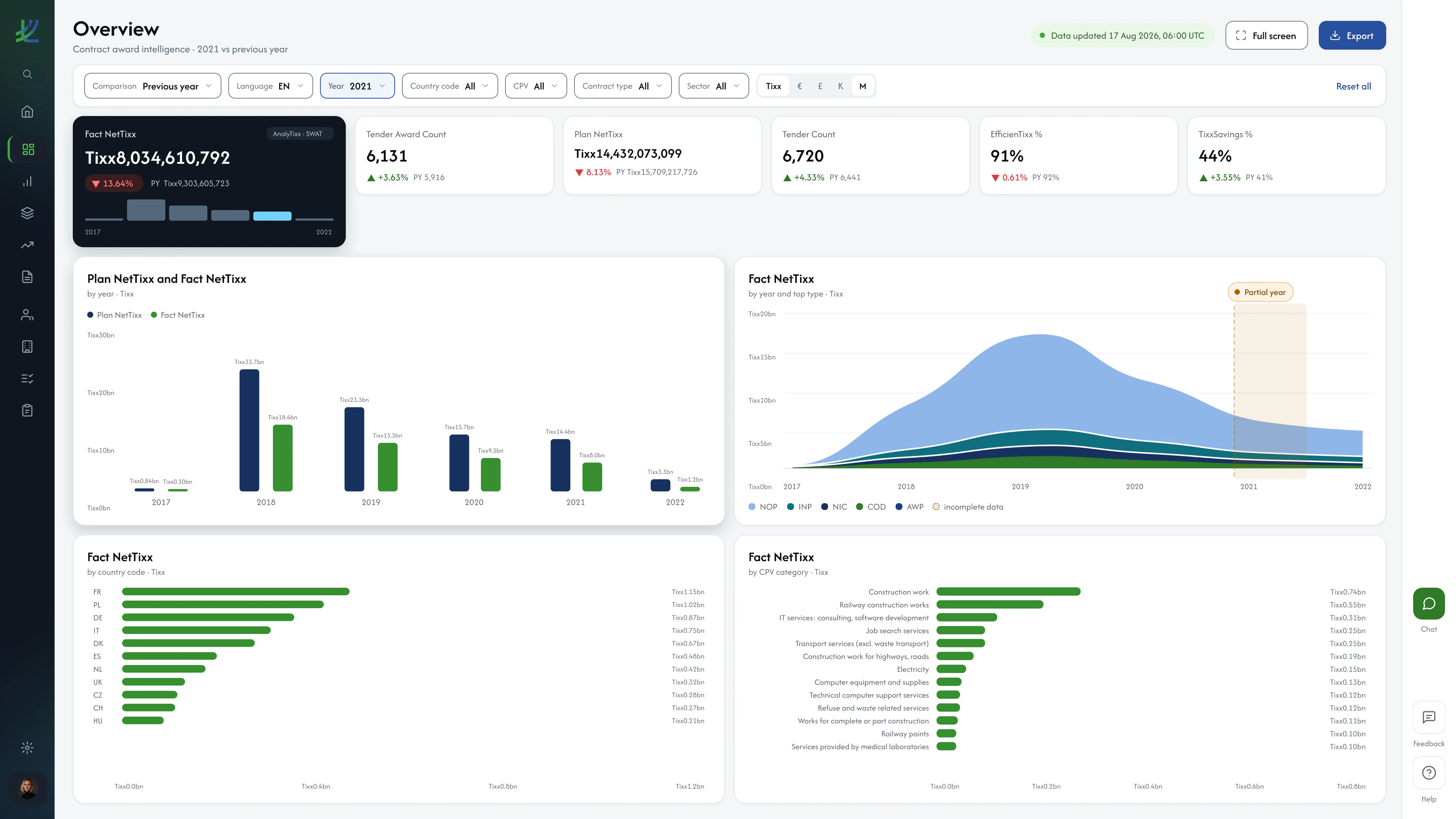

The scale is easy to underestimate. Every year, more than 250,000 public authorities in the EU spend around €2.6 trillion — about 15% of EU GDP — on services, works and supplies. A large part of that record is published in the open: TED, the EU's procurement journal, alone carries around 800,000 notices a year, worth more than €815 billion.
Public buyers are required to publish the result of every tender above certain thresholds. Each notice names the winning supplier and, in most cases, the value and duration of the contract. That is not an opinion or a survey — it is a record of money that will be spent.
01 — THE DATA
Where the money is committed
Grouped by sector and region, the awards show which markets take the largest share of committed spending — and how that share shifts from year to year.
Because many contracts run for several years, the contracts awarded today describe activity that will continue well into 2027 and 2028. The spending is decided now. The work, the hiring and the deliveries follow later.

Why awards are an early signal
A contract award comes before the invoices, the hiring and the purchases from subcontractors. When a region awards large infrastructure contracts, suppliers, materials and services will be needed there next.
An award is not yet a signed contract — the signature follows, and projects can still change. But as signals go, it is about as early and as concrete as public evidence gets.
What this record does not show
It is worth being honest about the limits. Notices can be published late. Some values are missing from the record. Purchases below the publication thresholds stay out of view. And some awards are framework agreements: a ceiling for future orders, not a guaranteed spend.
The signal is strong. It is not a complete picture — and it should be read that way.
02 — THE METHOD
From notices to market signals
datixxia™ groups awards by sector, location and period, so you can compare where commitments are growing and where they are slowing down.
The result is not a promise about the future. It is evidence about what has already been decided — so a supplier can see demand forming, and a planner can see which assumptions the data supports.

If your plans depend on demand that has not arrived yet, this record is worth reading.