
Hire ten people — you are betting demand will be there next year. Sign a three-year lease — a bet. Take a loan to buy equipment — a bet on orders that do not exist yet.
None of this feels like gambling. It feels like running a company. But each of these decisions is a commitment made today that only pays off if the future cooperates. The money leaves now. The return arrives months or years later — if it arrives.
That is what makes these decisions serious. Not their size, but the distance between the day you decide and the day you find out whether you were right.
The rear-view mirror problem
Most companies place these bets with data about the past: last year's revenue, last quarter's prices, the pipeline as it looked at the last review.
This works surprisingly well — as long as tomorrow looks like yesterday. It works until the road turns.
The problem is not that past data is wrong. It is that it is late. Revenue tells you what customers decided months ago. Prices tell you how yesterday's supply met yesterday's demand. By the time a downturn shows up in your accounts, it has already happened to your market. You are reading the news after the event.
Driving by the rearview mirror is fine on a straight road. The expensive moments are the turns.
01 — THE SIGNAL
Some of the future is already written down
Not everything about next year is unknowable. A surprising amount of it is already committed: signed, scheduled, and published.
Public contracts are the clearest example. When a public buyer awards a contract — for a rail line, a hospital, an IT system — the award notice becomes part of the public record. The work it describes is not a guess about the future. It is future work, scheduled, with money attached, often spanning two, three or four years.
Each notice is small news. Millions of them, read together, are something else: a map of demand that is already committed — sector by sector, country by country — before it shows up in anyone's revenue.

02 - THE EVIDENCE
Betting with evidence instead of habit evidence instead of habit
Forecasting is not about knowing the future. Nothing can promise that, and anyone who does is selling something.
Forecasting is about making your bets with evidence instead of habit. In practice, that means asking three questions before any big commitment:
- What is already committed in my market? Contracts awarded, projects scheduled, budgets allocated. This is the part of the future that is written down.
- Which way is demand moving? Not where it was last year — where the forward signals say it is heading.
- What would have to change for my plan to break? Every plan rests on assumptions. Name them, and you know what to watch.
Three questions. None of them needs a crystal ball. All of them need evidence that looks forward, not back.

This is not just for factories
A factory betting on a production line. A design studio deciding whether to grow the team. A newsroom planning an investigation that will take six months to publish. A supplier choosing which market to enter next.
All of them share the same shape of problem: work done today, paid back later. All of them are forecasting — the only question is whether they do it with evidence or by habit.
Where datixxia™ fits
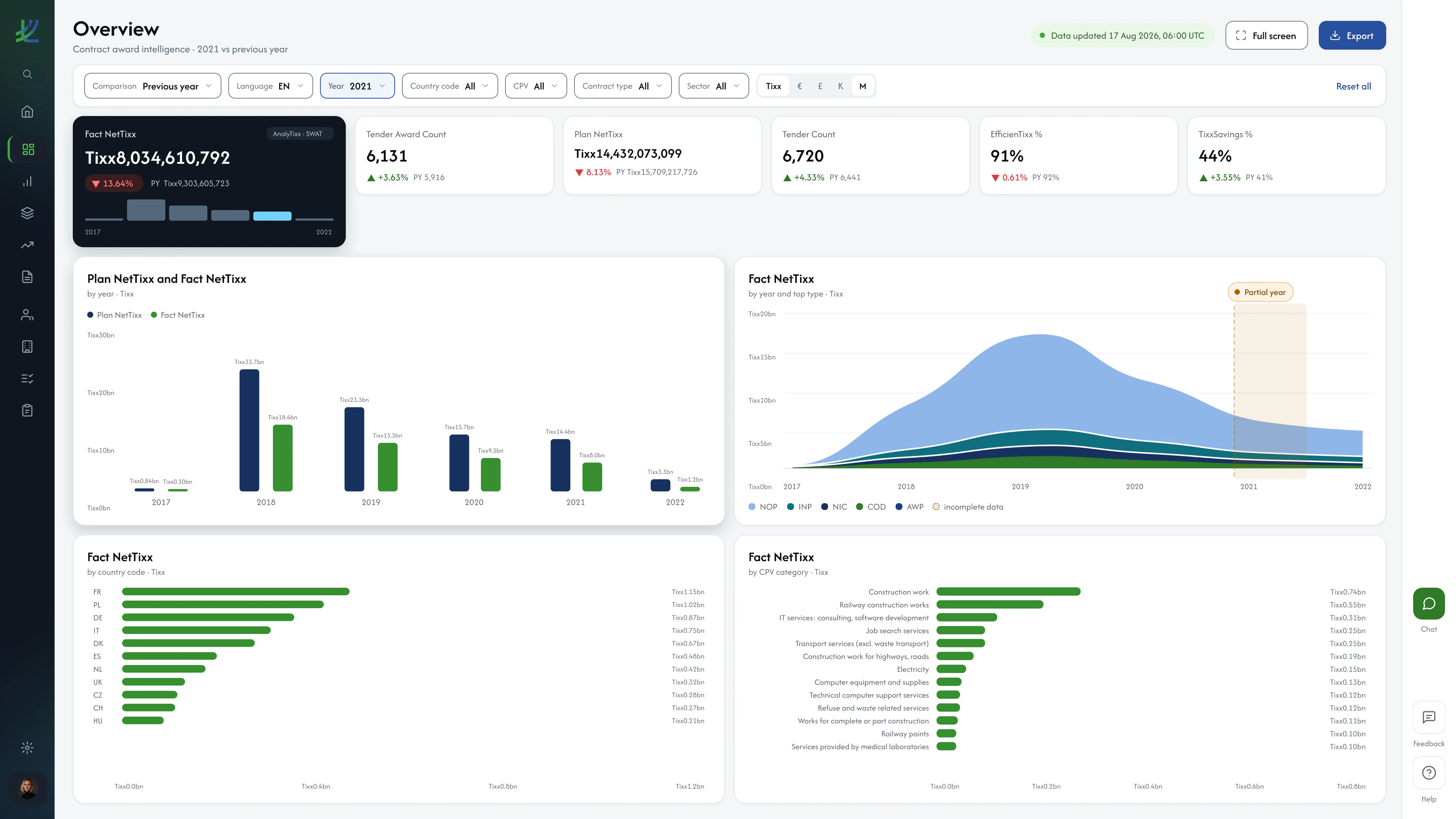
This is the problem datixxia™ is built for. It reads awarded public contracts — updated daily, across 194 countries — and turns them into sector forecasts: which markets have demand already committed for the years ahead, and which way it is moving.
The future is not fully knowable. But more of it is written down than most planning meetings assume. Our job is to make that part readable.
One question for your next planning meeting: which of our assumptions would hurt most if it is wrong — and what evidence are we watching for it?